
Why Am I Always Cold at Home When Everyone Else Is Fine?
If you are cold in a room where somebody else is comfortable, the room is not the variable. You are. That sounds like bad news and it is actually the opposite, because it means the thing to change is within reach.
Picture the usual evening. You are on the sofa with someone else. Same room, same radiator, same hour. They are fine. You have a jumper on, a blanket over your knees, and your feet are still cold.
Ask the internet about this and you will get answers about your house. Bleed the radiators. Check for draughts. Change the filter. Get someone to look at the boiler.
Some of that is worth doing. None of it explains the person sitting next to you who is fine.
What your body is actually doing
Here is the part that reframes the whole thing.
When you are in a cool room, your body treats your core as the thing worth protecting. Your chest, your organs, your brain. To keep that core warm it narrows the small blood vessels in your hands and feet, which shunts blood away from them and towards your internal organs. That is what Harvard Health describes happening when your core temperature drops. The skin further up the lower leg cools for the same reason, which is why the effect rarely stops neatly at the ankle.
Read that again, because it changes what you do about it. Your feet are not cold because something has gone wrong. They are cold because it is working. Your body has decided your toes are the acceptable loss.
Which explains why piling another jumper on your top half so often disappoints. You are insulating the part your body already decided to keep warm.
So here is the part most advice quietly skips: the honest goal is not to make your feet warm, it is to stop fighting a body that is doing its job. You will not win that fight with the thermostat. You would have to overheat the whole room to override what your body is doing, and even then you would be warming everything except the stretch that is actually cold. It is more targeted to warm the part your body gave up on than to warm the whole room, and it puts the heat where the cold actually is.
Why do your legs and feet go first?
Two things stack up here, and the second one is doing more damage than people realise.
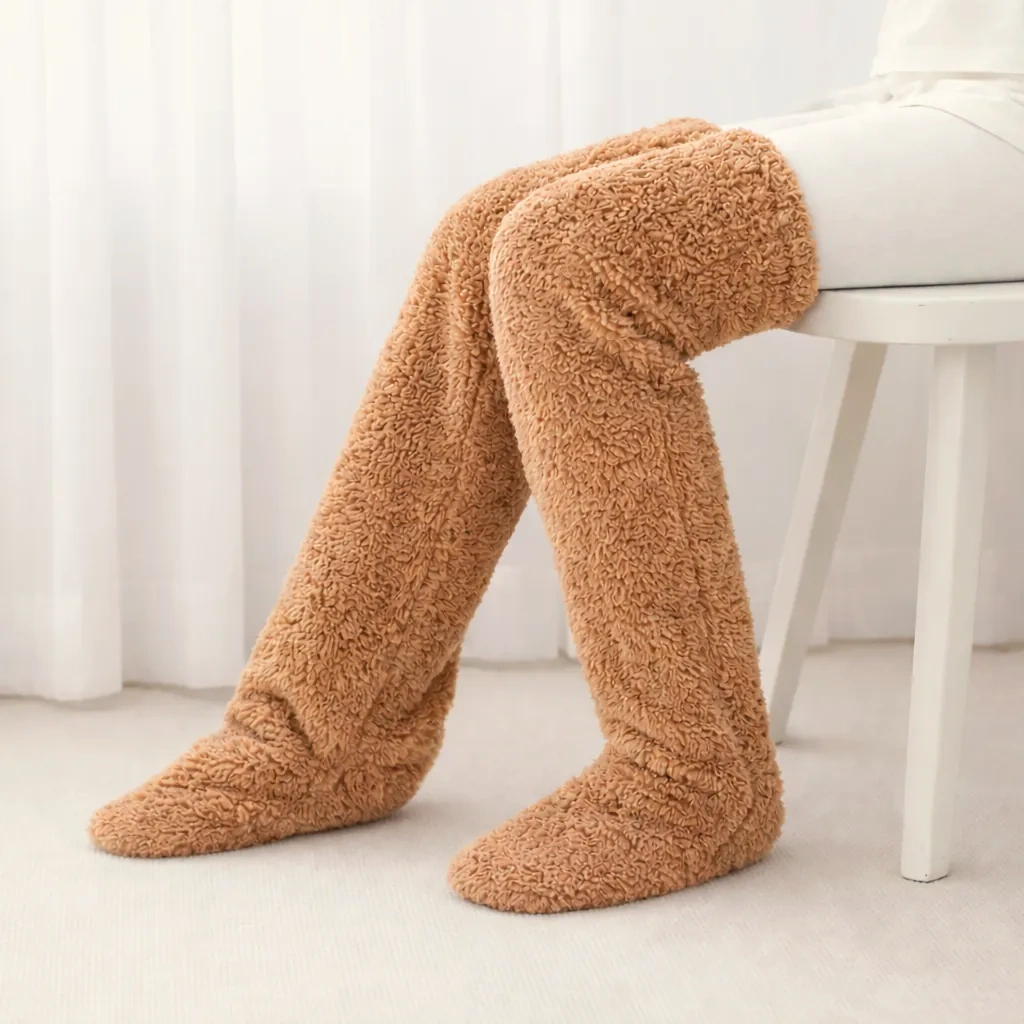
The first is the narrowing above. Hands and feet are furthest from the core and go first, and the skin of the lower leg follows for the same reason.
The second is that you are sitting still. Sitting is the default position for an evening at home, and still legs mean the muscle pump that moves blood is idle. So less warm blood reaches your legs at the very moment your body is already sending them less.
Then there is the gap nobody talks about. Many everyday socks stop at the ankle. Trousers and leggings are one thin layer. The stretch between your knee and your ankle, the part with very little on it, cools for the same reason your feet do.
Try this the next time you have been sitting for an hour. Put a hand on your shin, then on your thigh. The difference is usually obvious, and once you have felt it you cannot unfeel it.
Bedtime adds a mechanism of its own on top of all this, which is why why are my feet always cold at night is worth reading separately.
Why do you feel it more than other people?
There is no single answer here, and anyone who gives you one is guessing.
Body size and composition change how fast you lose heat, because a smaller body has more surface area for its volume. How much you have moved in the last hour matters. So does what you ate, how tired you are, and how well you slept.
Age and hormonal changes can make it more noticeable too, though the picture is more complicated than most articles admit. Feeling the cold more after 40 goes through what actually changes and what does not.
And it is not only home. If you are the person reaching for a cardigan in an office in July, why am I always cold in the office covers why buildings are so often calibrated for somebody else’s body. Shops, cinemas and trains have their own version of this, which is being cold in air-conditioned places.
Why does it get worse in the evening?
Most people notice this without connecting it.
You are at your stillest in the evening. You have stopped moving around the house. Your body temperature is drifting down towards its overnight low. The room has been cooling since the heating went off, even if the air still reads as warm.
It is not your imagination that nine o’clock is worse than three o’clock. The hour you are least likely to get up and move is the same hour your body is already rationing blood to your legs as you sit still, so the two effects land on top of each other instead of cancelling out.
What actually helps
Warm the part that is cold, not the part that is already warm. Four things follow from that, in the order they are worth trying:
- Move your legs. Stand, walk to the kitchen, go up the stairs once. Working muscles make heat exactly where you want it, and blood flow to them rises while they work. Another jumper on your top half can do neither.
- Cover the shin, not just the feet. A layer that reaches from the ankle to above the knee closes the stretch warm socks leave bare. Warm feet on their own leave the middle exposed.
- Layer thin rather than thick. Several thin layers trap air between them, and still air insulates better than fabric does. How to layer up to stay warm at home goes through what that means in practice.
- Stop heating the room to fix your body. If the room is already comfortable for someone else in it, turning it up warms the whole house to reach two cold shins. They stay cold because the problem is where your blood is going, not how warm the air is. The cheapest ways to stay warm without heating covers the wider approach, and how to keep your legs warm at home is the practical version for legs specifically.
That second point is what we sell, so here is our one honest line, in one place: our plush over-the-knee leg warmers cover the knee-to-ankle stretch, come in one size fitting roughly XS to L, and the foot section folds back, so you can have your feet in or out. They are made for indoors and a dry patio rather than for wearing out under boots. One customer summed up the design in their own words: “the option to have my feet in or out.”
If you want to know what makes a warm layer genuinely warm before you buy anything from anyone, the best fleece-lined leg warmers explains what to look at. The same thinking travels: staying warm camping is the outdoor version of the same problem.
When it is worth mentioning to a doctor
Most of this is ordinary. Bodies do this.
But some things are worth a conversation rather than another blanket. Numbness. Pain. Fingers or toes that change colour, going white or blue and then red. Cold that affects one side only. A change that came on suddenly rather than creeping in over years.
None of that means something is wrong. It means a clinician can tell you and an article cannot.
FAQ
If the room is the same for everyone in it, the room is not what differs. How quickly you lose heat from your hands, legs and feet varies from person to person, and it changes with how still you are sitting, your build, and sometimes your age or hormones.
When your body wants to protect its core temperature it narrows the blood vessels in your hands, feet and lower legs. Less warm blood reaches them, so they cool first. It is doing this on purpose, and socks stop at the ankle, which leaves the part that cools bare.
Often it is simply how your body loses heat when you sit still, and it can become more noticeable with age or hormonal changes. If it comes with numbness, pain, or your fingers or toes changing colour, it is worth speaking to a clinician rather than reading another article.
They can, for one specific reason: they cover the knee-to-ankle stretch that many everyday socks leave bare, which cools for the same reason your feet do. They add insulation to a length that usually has one thin layer on it. They will not change how your body rations blood flow, and they are not a treatment for anything.