
Fleece-Lined Leg Warmers: How to Check a Pair Stays Up
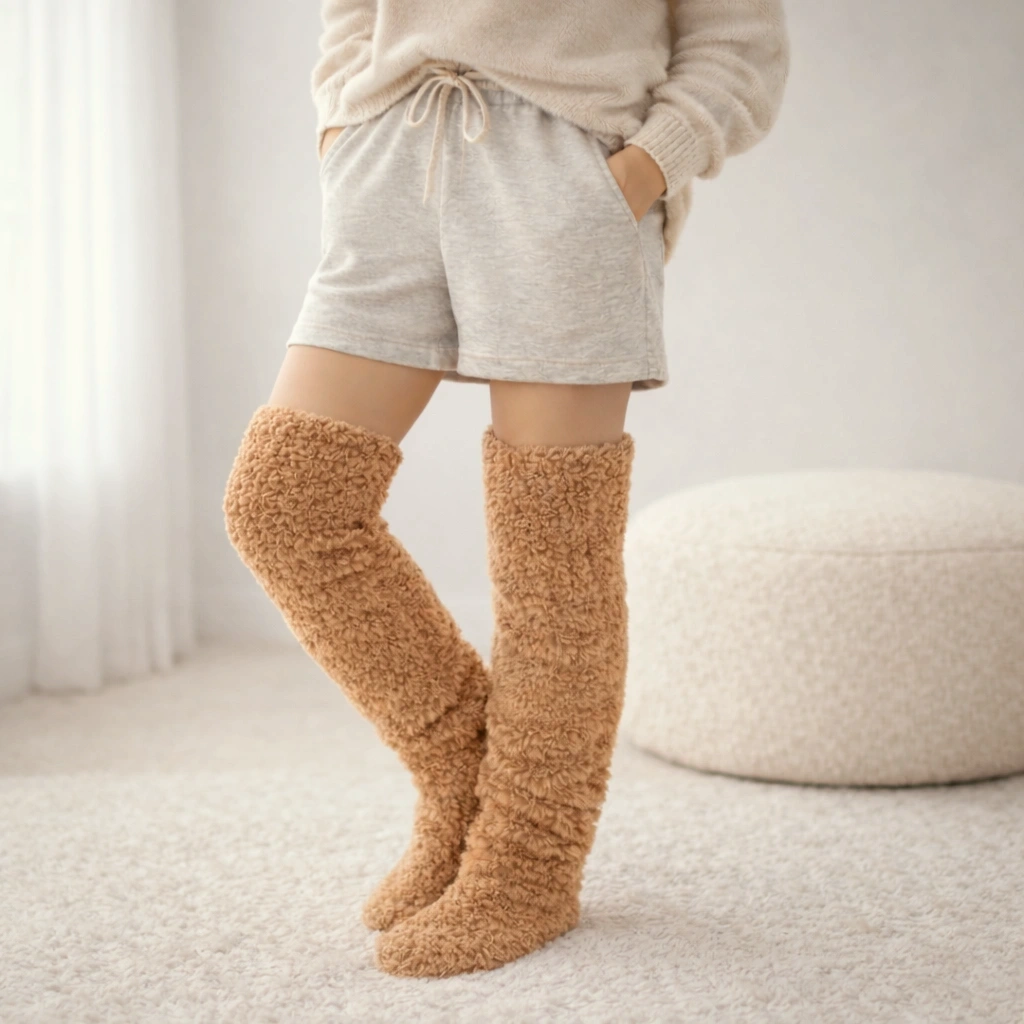
Open a “best fleece lined leg warmers” list and it will usually rank on warmth. That is the wrong first question. The warmest pair in the world is no use if it slides to your ankles by mid-morning. That pair lives in a drawer by February. Warmth matters. We would still check fit and the top band first. The pair you keep reaching for is the one that stays where you put it. After that, what separates a good pair from a forgettable one is how far up your leg it reaches, not the things the listings we read all claim anyway.
No listing can prove either of those on your leg. So this is a guide to what you can check before you order, not a ranking of pairs we have tested.
What should you look for in fleece-lined leg warmers?
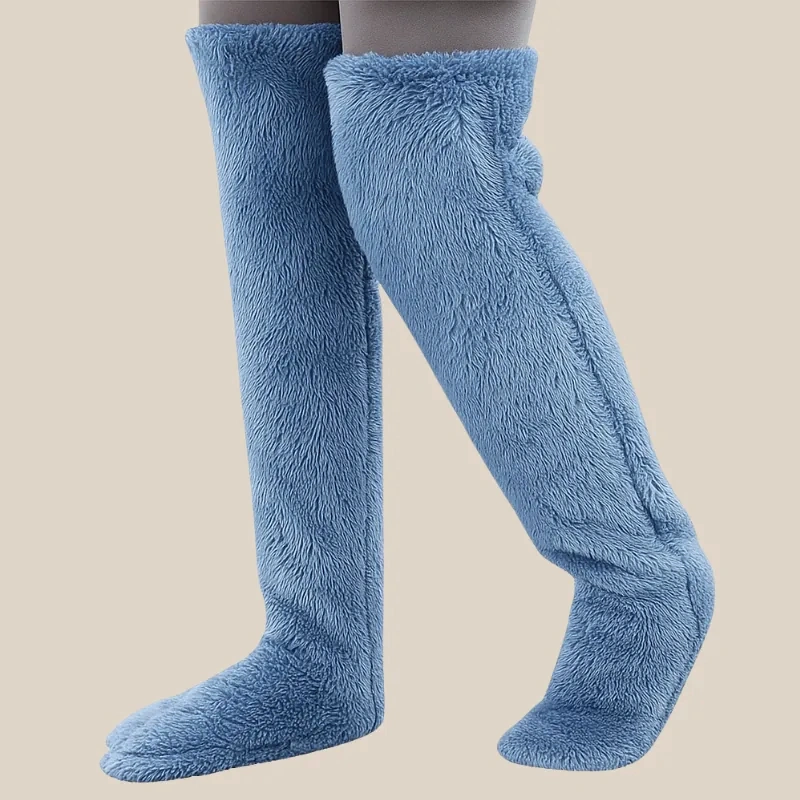
Six things get compared on pairs like these: whether they stay up, coverage, the fleece itself, the foot, the fit range, and easy care. You can only check two of them before you buy. Whether a pair stays put decides whether you wear it at all, because the one you tug up every ten minutes is the one that ends up in a drawer. Coverage decides how much of your leg gets the extra layer. The other four are either a matter of taste or a claim that every budget listing we read already makes. The table below sets out which of the six you can check before you buy and which you cannot, and puts the budget end beside it.
| What to look for | Why it matters | The budget end (same design, several logos) | Ours | Consider before buying |
|---|---|---|---|---|
| Stays put | A top band can slow the slide while you sit; the pair that slides is the pair you stop wearing | A non-slip sole on the two listings that describe one, and nothing about the band on any of them | Elasticated top | Depends on the garment’s measurements and yours, not on the band alone |
| Over-the-knee coverage | Short socks cover the foot and ankle, so calves and knees keep whatever you put over them | Often over-the-knee as well | Over-the-knee as standard | May feel long on shorter legs |
| Fleece construction and feel | A lofty pile traps air while you sit still; softness is not a warmth rating | Teddy fleece on the listings we read | Plush teddy-fleece, blanket-soft on both sides | No published tog or Rct result |
| Heel and foot | Some pairs stop at the ankle and leave it to your own socks; others cover it | Two of the three listings describe a non-slip sole, so the foot is covered; the third says nothing about it | The foot section folds back, so you can have your feet in or out | Not made for wearing inside closed shoes or out on the street |
| Fit range | A stretchy fit suits more leg shapes | One size: UK 3-7 on two of the listings, UK 5-7 on a third, and either way that is a shoe size and not a leg measurement | One size, stretch fit | No published calf range either |
| Easy care | Machine washing keeps them fresh through winter | Not stated on the listings we read | Machine wash at 30°C per our care guidance | Always follow the label on your own pair |
The budget column is the over-the-knee teddy design listed by Online Home Shop and sold under the Boohoo, The Range and B&Q names. We read the Boohoo page in June 2026 and it no longer resolves, so the three live listings behind this column are Online Home Shop, The Range and B&Q, all checked again on 27 July 2026. Online Home Shop and B&Q carry the same construction and the same non-slip sole wording, and B&Q runs Online Home Shop’s description with the brand name lifted out of it, which is why we treat them as one design. The Range sells the same design under the Online Home Shop name, with a shorter write-up that does not mention a sole at all. We did not confirm the manufacturer with any of the sellers. Those are listing claims, not measurements, and neither is our own column. Heat Holders is the one brand we found printing a warmth figure at all on a comparable pair: an official 2.3 tog on its full leg warmers, alongside a length of 61cm laid flat. The page we read does not name the test method or the laboratory behind that figure, and nothing else in this table has been through one that we can check, ours included.
One row in that table is worth reading twice. A non-slip sole is a grip feature for the floor: it says nothing about whether the top of the garment will slide down your leg. Nor does “fits UK 3-7”, which describes a foot. Ours has no non-slip sole either, which matters for the other half of what that feature does: on carpet it changes nothing, but on a hard floor a fleece foot is a sock, not a slipper.
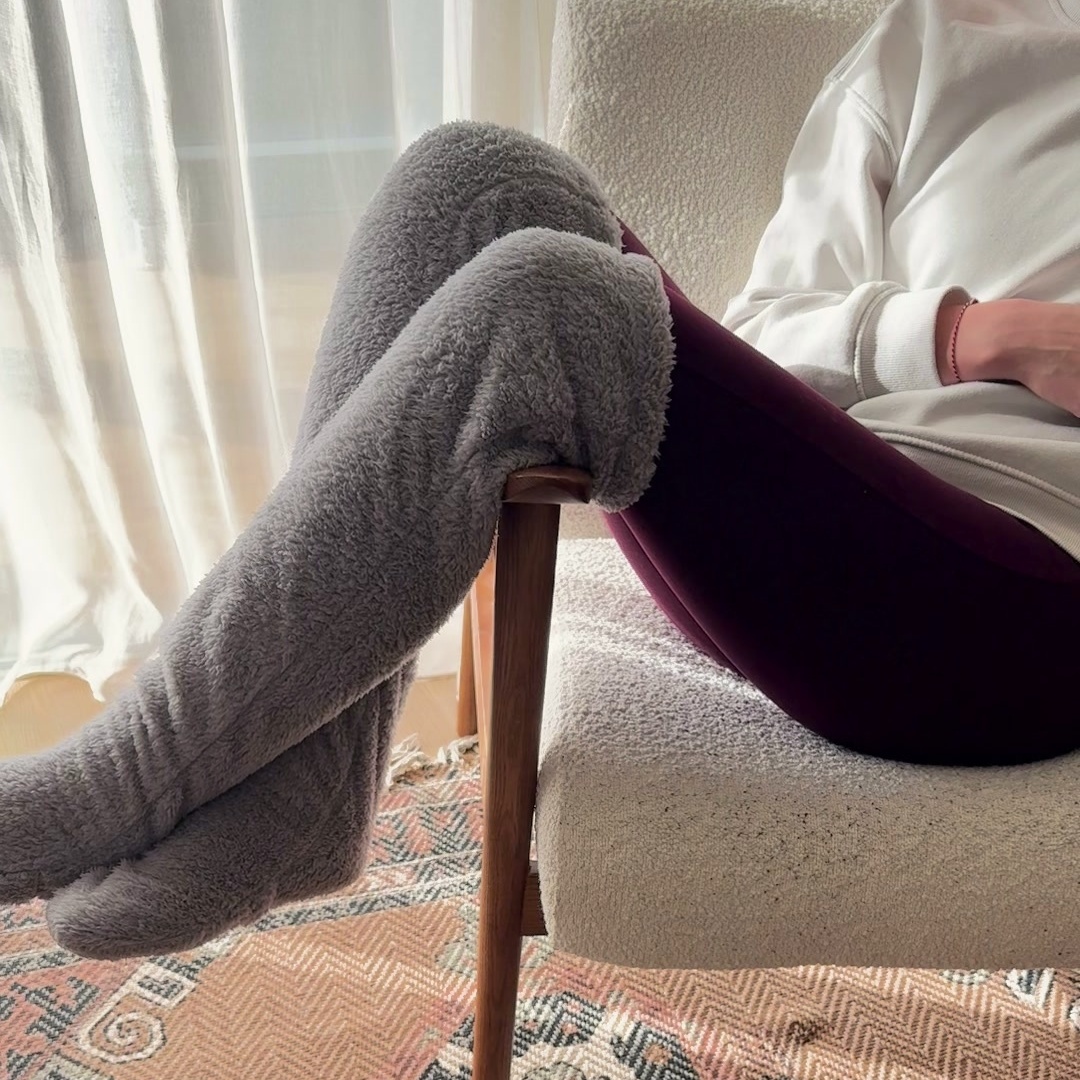
So: two rows you can check, one is a matter of taste, and three give you nothing to compare. Teddy fleece is claimed on every budget listing we read, and care is not stated on any of them, so neither column separates one pair from another. Neither our listing nor theirs publishes a calf measurement, so the fit range is a blank on both sides. The foot is a genuine difference, but a preference rather than better or worse. The two worth your attention are whether a pair stays up and how far up your leg it reaches, and neither can be read off a photograph.
What makes fleece leg warmers less likely to slip?
Ask anyone who has owned a bad pair. The ones that slide to your ankles get abandoned in a drawer, however warm the fleece is. Staying up quietly decides whether they get worn at all, and the top band is only part of it. An elasticated top is meant to slow that slide while you sit at a desk or curl up on the sofa, and whether it grips without digging in depends on the band tension and on your own measurements. The rest of the garment pulls on the same result: how wide and how long it is cut, how much it weighs hanging off your calf, how well the stretch recovers after a wash, and how slippery the layer underneath is.
Fit across a range of legs is the hardest thing for a one-size pair to get right. In a review on our own product page, a customer reported that our pair “don’t slip off even from a slimmer leg, and don’t feel tight on a thicker one.” That is how it landed for that customer, on their legs. Without published garment measurements or wear testing across sizes, it is not a result we can promise you. If you have fuller or longer legs and want more on fit, plus-size and thigh-high leg warmers goes into stay-up fit in more detail.
Two things you can do before spending anything. Measure the widest part of your calf with a tape, or a piece of string against a ruler, and write the number down: it turns every “one size” listing from a guess into a yes or a no. It is also a number our own listing does not publish, which is exactly why the tape is worth two minutes. Use it as a filter: if a listing gives you a calf range, you can rule the pair in or out in five seconds. If it gives you no calf measurement, ours included, you are buying on a size label and a returns policy rather than on the fit, and that is worth knowing before you order rather than after. And if you already own a pair that slides, try them over socks rather than under them. One of our customers wears a pair that way, over the socks and pulled up over pyjama legs. On that pair it is the elasticated top that does the holding; over the socks is simply the arrangement they landed on.
What makes one pair of fleece leg warmers warmer than another?
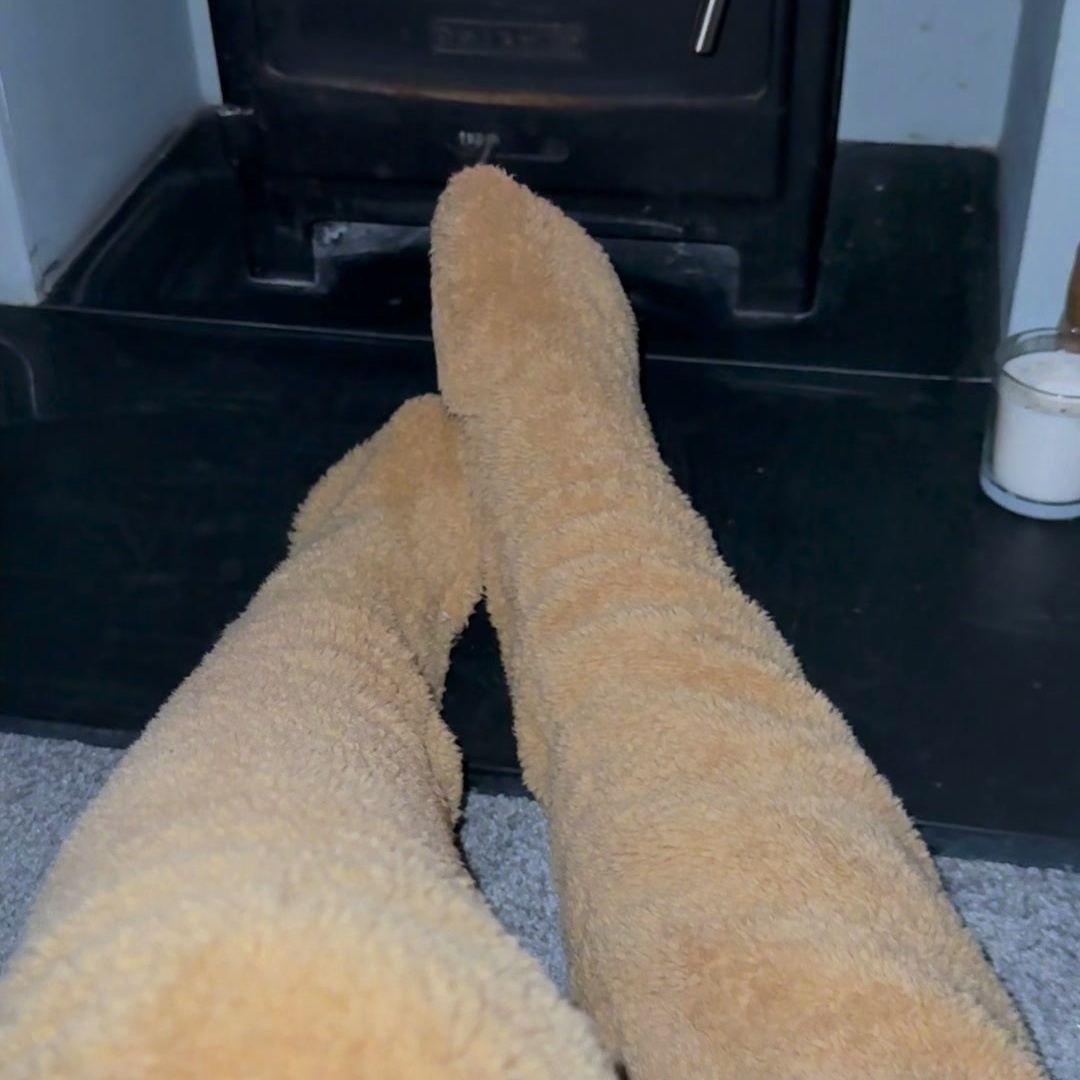
Warmth comes from the fleece itself and from how much of your leg it covers. Polar fleece is a polyester fabric that has been napped. Brushing the surface raises a pile of fine fibres that traps tiny pockets of still air, and it is that trapped air, warmed by your body, that does the insulating. The testing laboratory SATRA puts the principle plainly: air is a very effective insulator, and many garments rely on trapping a layer of still air to prevent heat loss. Loftier constructions generally hold more of that air, which is why fleece feels warm for its weight. Softness is a separate thing from a tested warmth rating, though, and appearance alone will not tell you the second. Coverage matters too, because insulation only works on the part it actually covers. A pair that reaches over the knee puts that layer over your calves and knees. An ankle-length pair leaves them without it.
Material names confuse easily. One means less than it looks: what the word thermal does and does not tell you explains why so few of the listings we read publish a warmth figure at all, and why the rare ones that do are still hard to compare. If you are weighing a pair against thick socks instead, how leg warmers and thermal socks differ covers which problem each one solves. One customer, reviewing the pair on our product page, put it plainly: “These are a wonderful invention, they are thick and keep your legs very warm.”
Over-the-knee or knee-high: what length is best?
Over-the-knee aims at the knees and shins, the stretch most socks leave bare, though where a pair lands depends on your leg length. It suits you if that is where you feel the cold. It is not automatically the better choice. Knee-high can feel less restrictive and takes one fit question off the table, since nothing has to sit around the upper leg; your calf measurement still decides. It also sits better if you dislike a layer over the knee.
The foot is worth thinking about alongside length. On ours the foot section folds back, so you can have your feet in or out: tucked in on the sofa, slipped out when you want slippers or want to step into something at the door. One customer, reviewing on our product page, described the practical half of it: “the toe flaps up so you don’t need to take them off.” Not everyone loves it: another review on the same page calls the flap “a little annoying”, while still rating the pair, and that is a fair description of the trade. A flap you can fold away is one more thing to fold away.
What a pair costs in the UK, and why the cheap end all looks alike
Start with like for like, because the spread mixes categories. Heat Holders’ full leg warmers, the nearest thing to ours we found, were £24.99 with a stated 2.3 tog when we checked on 27 July 2026. Our own over-the-knee pair is also £24.99, and we have no tog figure to put beside theirs. Their lounge socks are a different garment at about £12.99 to £14.99.
Below that sits the unbranded over-the-knee teddy design. The Range listed it at £7.49 to £9.49 when we looked again on 27 July 2026, having been around £4 to £8 in June. Online Home Shop runs it between £4 and £12 on one page, depending on the colour and on whether you read the sale price or the one crossed out beside it. Boohoo listed it at around £5 to £8 in June, on a page that no longer resolves. Dunelm’s £1.75 to £7 is for teddy slipper socks, which cover the foot and ankle rather than the leg, so it is a different product rather than a cheap version of this one. In our own June sweep, Amazon listings advertised from roughly £6, but we did not record individual sellers or variants there, so treat that as the lowest price we saw rather than a price for anything specific. Those are the advertised prices we could read on UK pages between June and July 2026, they move with sales, and none of it is a like-for-like comparison of what you actually get.
The more useful thing is what the spread hides. Much of the budget end looks like one design under several logos rather than many different products, which is why the photos and the “one size” wording feel so familiar as you click between shops. We could not confirm who manufactures it, and the practical point survives either way: two cheap pairs from different shops may be the same pair, so paying twice to try both may tell you nothing new. The real choice is between that pattern and something specified differently, not between the shops selling it.
Explore the guides
Choose the guide that matches what you are weighing up:
- What the word thermal does and does not tell you. Why almost no pair publishes a warmth figure, why the rare exceptions are hard to compare, and what to check instead.
- How leg warmers and thermal socks differ. Which of the two solves the cold you actually have.
- Plus-size and thigh-high leg warmers. Inclusive fit and staying up on fuller or longer legs.
- How to wash fleece leg warmers. Keeping the pile that does the insulating.
Still deciding whether a layer like this helps at all? whether leg warmers actually work answers that one first, and how to keep your legs warm without turning up the heating covers the wider picture. Where to buy fleece leg warmers in the UK is there for when you are ready to choose a pair.
Want an over-the-knee fleece pair with an elasticated top, worn barefoot or with slippers? That is what our plush pair is designed for. You can see the colours and where to buy when you are ready.
Whether any pair earns its keep comes down to fit, coverage and how the foot suits the way you sit at home, and a fleece label settles none of the three. That is why measurements and a workable returns policy are worth more than the word thermal.
The real test comes weeks later, on an ordinary evening. The pair is on the arm of the chair where you left it, not folded at the back of a drawer. You pull it up over your knees, tuck your feet in, and the cold that had been sitting on your shins gets quieter.
FAQ
Start with your own calf measurement and the coverage you want, then compare the top construction, the fleece claim, how the foot is handled, the care label and the returns policy. Six things get compared on listings like these, but you can only check two of them before you buy: whether a pair is likely to stay up on your leg, and how far up it reaches. How the foot is handled is a trade-off rather than a ranking: some pairs stop at the ankle and leave it to your own socks, some cover it, and a few fold back so you can have your feet in or out. Warmth itself is the one you cannot verify from a listing.
They can, but the result depends on the garment’s measurements and construction as much as on the elastic, and on your own leg shape. An elasticated top is meant to slow the slide rather than guarantee it will not happen. Look for stated measurements, and give more weight to reviews that mention them.