
Leg Warmers or Socks? The Difference Is Above the Ankle
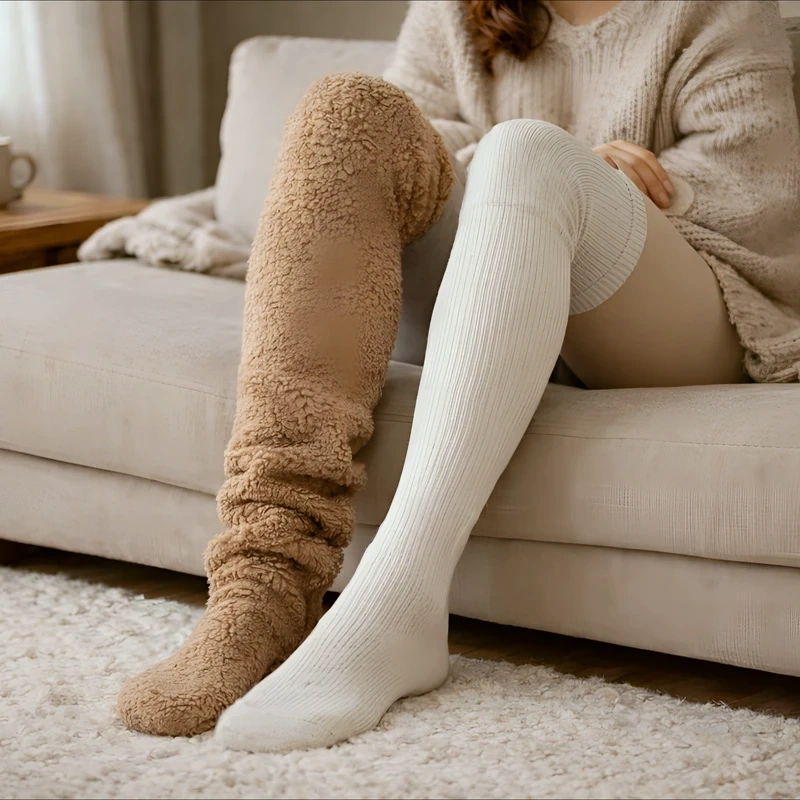
Socks warm your feet. The part above them is the one everyone forgets. A sock always covers the foot. Its height varies wildly, from below the ankle to above the knee. A leg warmer starts at the ankle and works upwards, over the calf and often the knee. For warmth, that is the difference that decides which one you want, and it sounds too obvious to write down until you notice it settles the question: buy for the part of you that is actually cold. If your toes are cold, socks do more. If your feet are fine and the chill sits higher up, a short sock stops below it.
What is the difference between leg warmers and thermal socks?
For warmth, the biggest difference is reach. Socks run anywhere from no-show to over the knee, but their job is the foot, where a shoe or slipper already sits. A leg warmer starts at the ankle and runs up the calf in one soft sleeve. Some styles stop below the knee, some go over it, and most stop short of the foot, though not all of them do.
Two people can sit in the same room, on the same evening, in the same thick socks. One of them cannot get their toes warm. The other has comfortable feet and a cold band running from ankle to knee. The product did not vary. The cold did.
That splits the aisle three ways rather than two. Some indoor designs sit between the categories. They run up the calf like a leg warmer. The foot section folds back, so you can have your feet in or out.
| Where the cold sits | The layer that reaches it |
|---|---|
| Toes and feet | Thermal socks |
| Calves or knees, feet already comfortable | Leg warmers |
| Both, or your feet want covering only some of the time | An indoor pair whose foot section folds back |
Are leg warmers warmer than thick socks?
We cannot tell you which fabric holds more heat per square inch, because we have not found a test that measures both the same way. What we can compare is WHERE each one adds a layer.
There is a table of how much each garment adds to your insulation, in a unit called clo. We took it from an open thermal-comfort library, which lists the values without saying where they came from. The same documentation cites the ISO 9920 standard for its calculation formulas, but not for this table, so treat the figures below as a reference point rather than the last word.
| Garment | Insulation (clo) |
|---|---|
| Ankle socks | 0.02 |
| Calf-length socks | 0.03 |
| Thick knee socks | 0.06 |
Read those rows carefully, because they are generic entries rather than matched products. The table lists an ankle sock and a calf-length sock, and the second carries 0.01 clo more. That is half again in relative terms. But nothing in the table says the two were built the same way, so the gap cannot be pinned on height alone. The third row moves two things at once by its own description, because a thick knee sock is both longer and heavier. So take these figures as reach plus build, not as a clean test of coverage against thickness, and take the three times as a listed insulation contribution rather than a promise that it feels three times warmer. The table has no row for a fleece leg warmer, and we have no lab measurement to add one. How coverage and construction each play into comfort is the subject of our piece on whether leg warmers actually work.
What about the numbers on sock packaging?
Socks are one of the few places in this aisle where a warmth figure does appear at all. Heat Holders publishes tog ratings for its thermal socks, which makes them unusually specific for this shelf. Tog is the same warmth scale printed on duvets, where a higher number means more insulation.
Read in July 2026, that page rates its Original sock at 2.34 tog, its Lite at 1.6 and its Ultra Lite at 1.0, alongside its own comparative claims: seven times warmer than a cotton sock, almost three times an ordinary thermal one. The page explains in general terms what tog measures, but it does not name the test standard or the laboratory behind those figures. Unless a seller names both, you cannot line one brand’s number up against another’s. Why that makes a warmth figure on clothing so hard to compare is a longer story.
A number you can see beats a vague warmth claim, but only if you can find out how it was measured. Without that, it is confidence rather than comparison.
Can you wear leg warmers instead of socks?
You can, and in a warm house plenty of people do. Most leg warmers stop at the ankle and hand the foot back to whatever you already had on, so on their own they are the wrong swap if your feet run cold.
Wearing both is the arrangement that survives an actual evening. Warm socks underneath, soft fleece above. Slippers go on and come off, the kettle boils, someone answers the door, and the layer above stays wearable through all of it. How much any pair shifts comes down to fit. A pair you have to peel off to put shoes on is a pair that ends up over the back of a chair by February.
A pair built that way may suit you if:
- your feet are comfortable in socks, but the cold carries on above the ankle,
- you want your feet covered while you sit and free when you get up,
- you are warming up at home, at a desk or on the sofa, rather than heading out.
If your toes are the cold part, this is the wrong end of the problem, and a thermal sock is the cheaper answer.
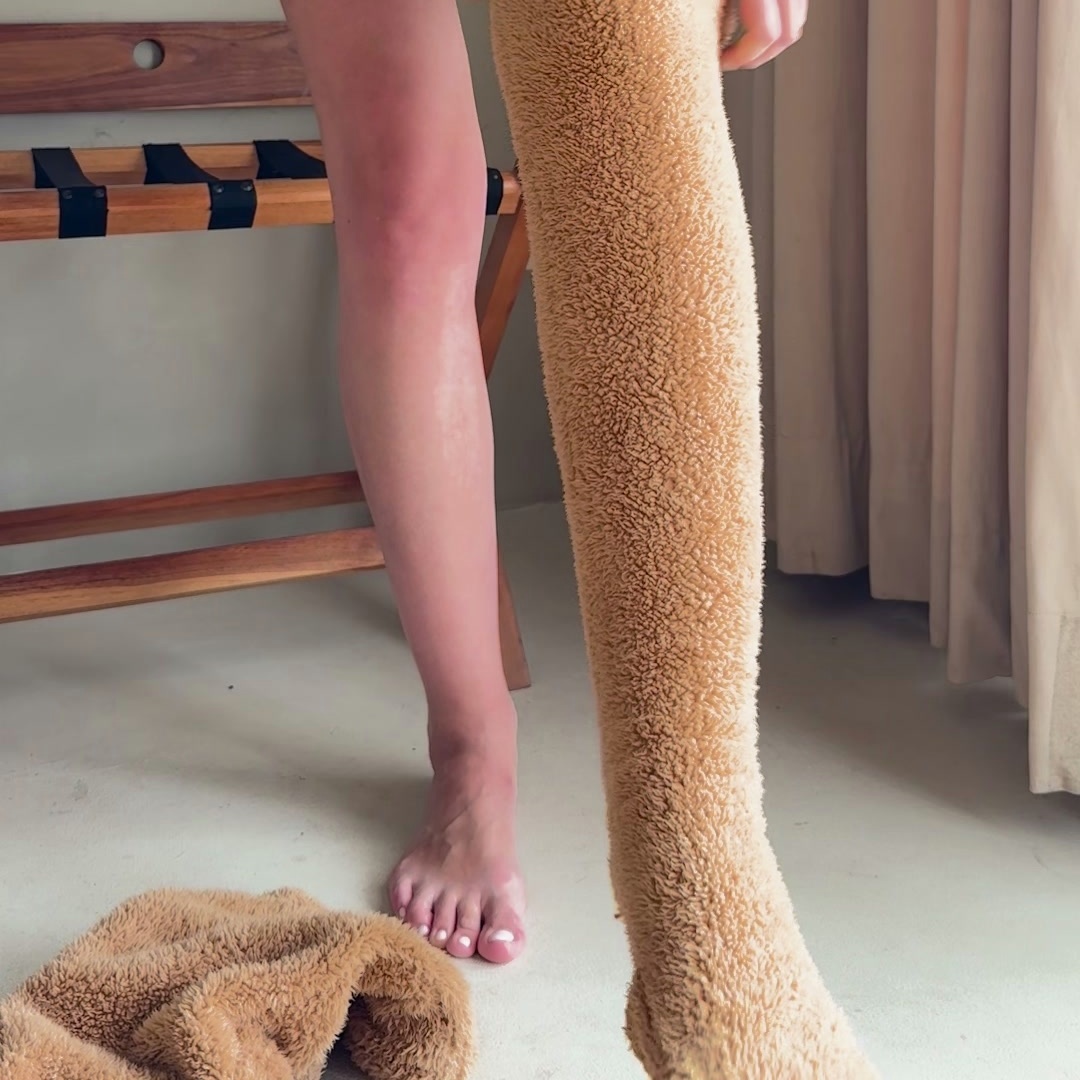
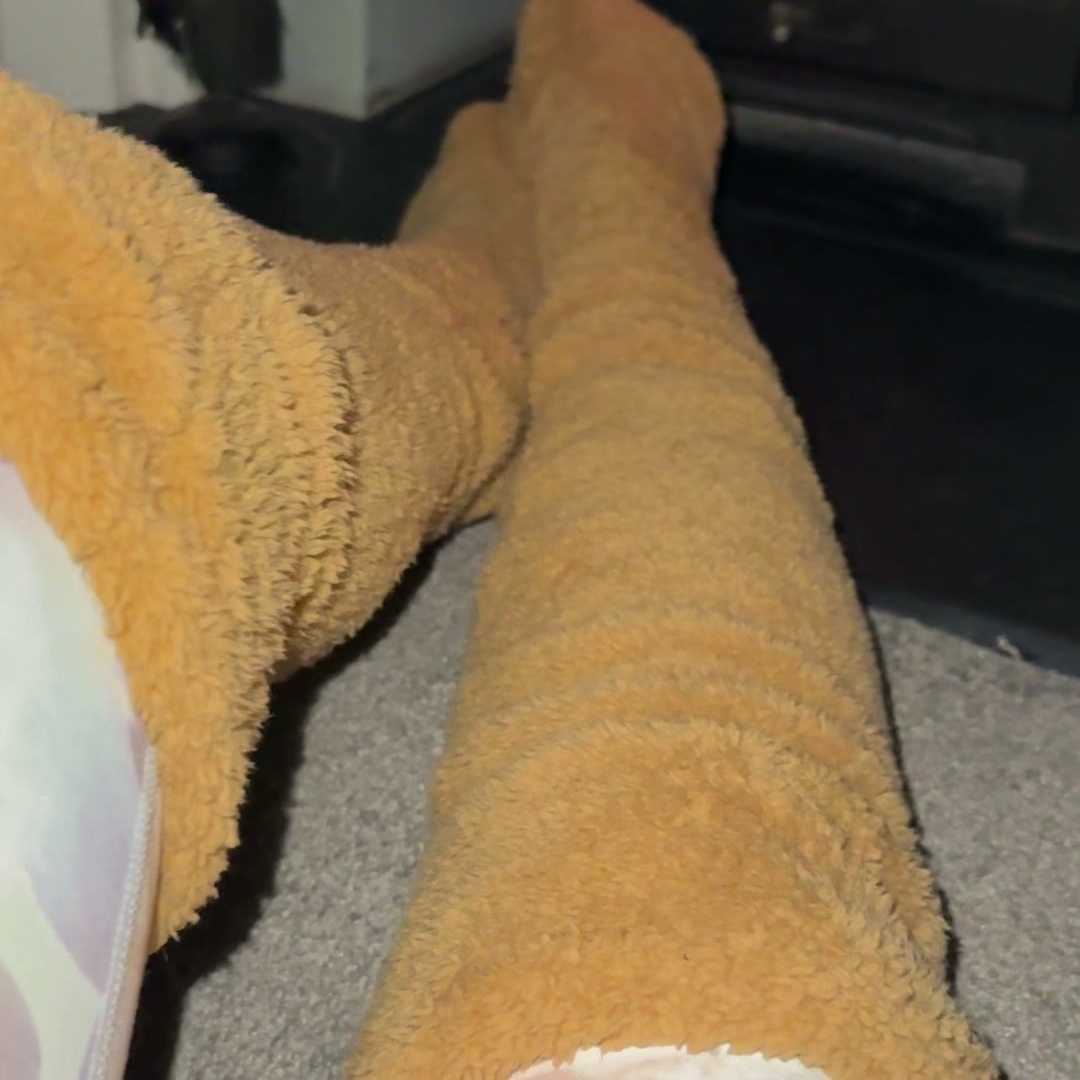
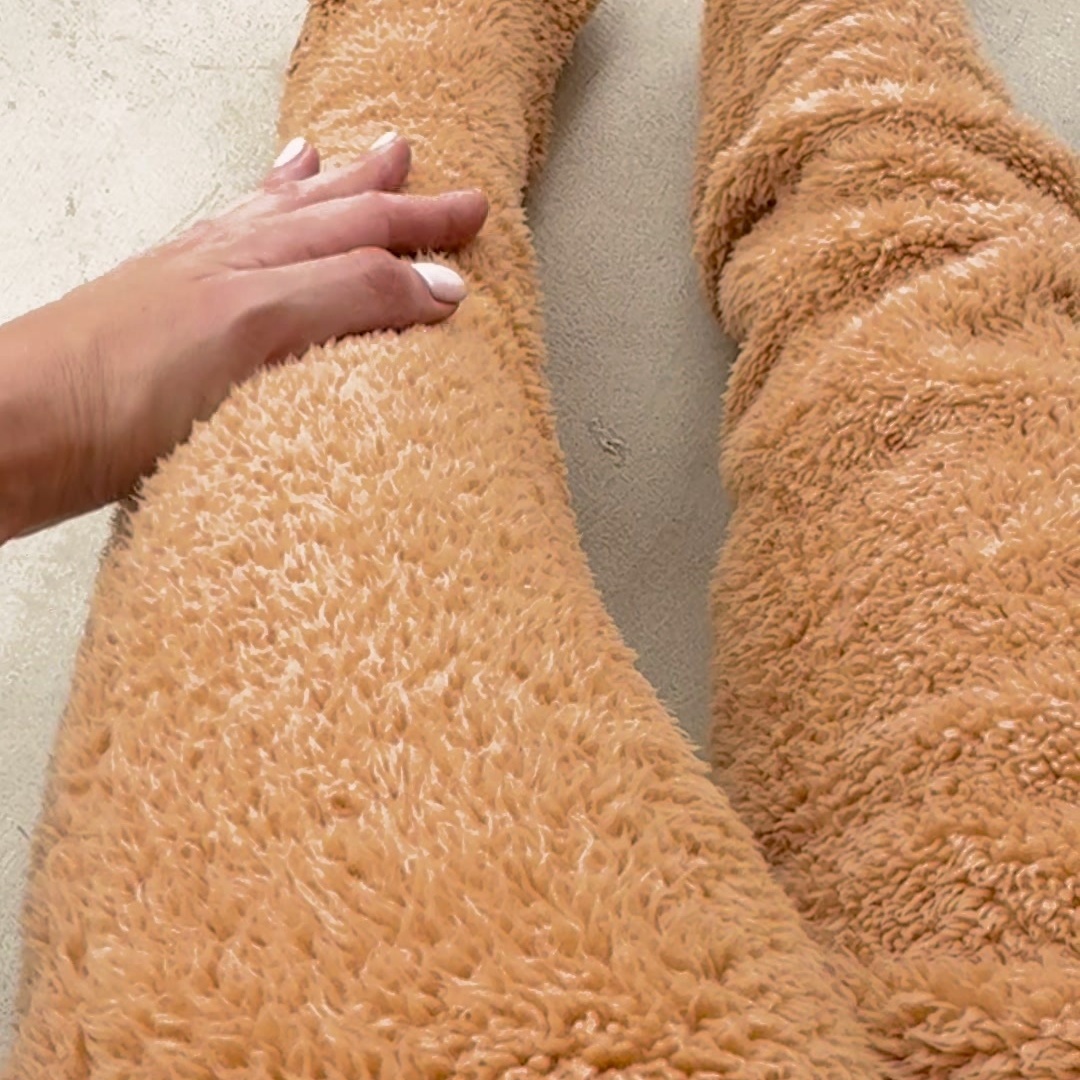
That evening is what our own pair is built around. It covers the foot, with a flap you can fold under to slip your feet out. One customer, reviewing the pair on our product page, named that as the part they valued: “the option to have my feet in or out.” They reach over the knee in plush teddy fleece, and at the time of writing our product page lists them at £24.99 a pair. They are made for wearing around the house, or briefly on a dry patio, not inside closed shoes or out on the pavement. For the full run of what separates one pair from another, see our buyer’s guide to fleece-lined leg warmers.
Why does a cold calf creep up on you?
Your skin does not report cold evenly, and in the one map we could find, the lower leg answered more quietly than most other places on the body. A 2019 paper in Building and Environment (DOI 10.1016/j.buildenv.2019.106435) touched a small thermal probe to 318 skin spots across one side of the body and asked people to rate what they felt. The foot and lower leg came out among the least sensitive areas mapped, below the average response across the whole map. The cheek, the back of the neck and the seat area came out two to three times as sensitive as that same average. Every region reacted more strongly to cooling than to warming, by a factor of 1.3 to 1.6. Read it as a measure of a brief touch on one spot, not of how fast a cold room takes heat off you.
A smaller study of eight women, published in Physiology and Behavior, points the same way: cold sensation was strongest at the head and torso and fell away towards the extremities. Eight people is not a base to build a rule on, so take it as agreement with the direction, not as a second measurement.
Be careful what you take from that. Both studies measured how a brief stimulus feels on one spot. Neither watched a calf cool in a room. Neither can tell you when a person notices. What they do show is that the same stimulus does not land equally everywhere. That is reason enough to treat your feet and your calves as two questions, not one. And what any of this measures is sensation, not heat leaving you, so the check below asks what each part feels like rather than what your hand says it is.
Find out which cold you have
Most of us treat one cold leg as one problem. It is worth splitting it in two, because the feet and the calves can give you different answers. You can narrow it down tonight without spending anything, and the answer may well be socks. This is a home check, not a laboratory.
Put on the thickest socks you already own. Sit the way you normally sit, and give it a full hour. Then rate two places separately, by how they FEEL rather than by touching them: your toes, and your calves and knees. Your hand is a poor thermometer, and comfort is what you are after anyway.
If your feet are comfortable and your calves or knees still are not, a thicker version of the same short sock is unlikely to reach what is bothering you. The layer you want has to carry on above the ankle, and that is the stretch ours are cut for. If your toes are the part still complaining, that is where to spend, and socks are a cheaper place to spend it than anything we sell.
And if both are fine, you have saved yourself a purchase. By the end of that hour you will have your answer: the floor still cold under your feet, or your shins gone quiet, or neither. Whichever it is, you know something a warmth adjective on a packet was never going to tell you: how far up the next layer needs to reach.
FAQ
You can, and the two are not rivals. A sock always covers the foot and its height varies a lot; a leg warmer concentrates on the lower leg, though some indoor pairs cover the foot too. A pair whose foot section folds back lets you keep your usual socks or slippers on and add coverage above them, which is the point of wearing both.
We cannot tell you which holds more heat per square inch, because we have not found a test that measures both the same way. What changes is reach. In the reference insulation table, a thick knee sock is listed at three times the figure of an ankle sock, which is a difference in listed insulation, not a promise that it feels three times warmer. That table has no row for a fleece leg warmer, and we have no lab measurement to add one.