
How to Warm a Cold Rented Flat in England or Wales (and When It Is Not Yours to Fix)
Every guide for cold renters opens the same way. Buy a draught excluder. Hang thicker curtains. That advice is half of an answer. It skips the first question worth asking. Is this home simply chilly, or is there a problem with the heating, insulation, draughts or disrepair that your landlord may be responsible for putting right?
The short version, before the detail. Warm yourself and the few feet around you tonight, keep every fix removable so it leaves with you, and report anything the flat itself is doing wrong. That last part is the one most guides leave out, and some of it may not be yours to fix at all.
England and Wales part company here. The two nations use different legal routes, so they are explained separately below. Housing law in Scotland and Northern Ireland works differently again, and this guide will not help you there. None of it is legal advice.
What is the usual advice missing?
You know the list already. A draught excluder at the front door. Thermal curtains, closed before dusk. A rug on the hard floor. Film on the single glazing.
None of that is wrong. It genuinely helps on an ordinary chilly evening.
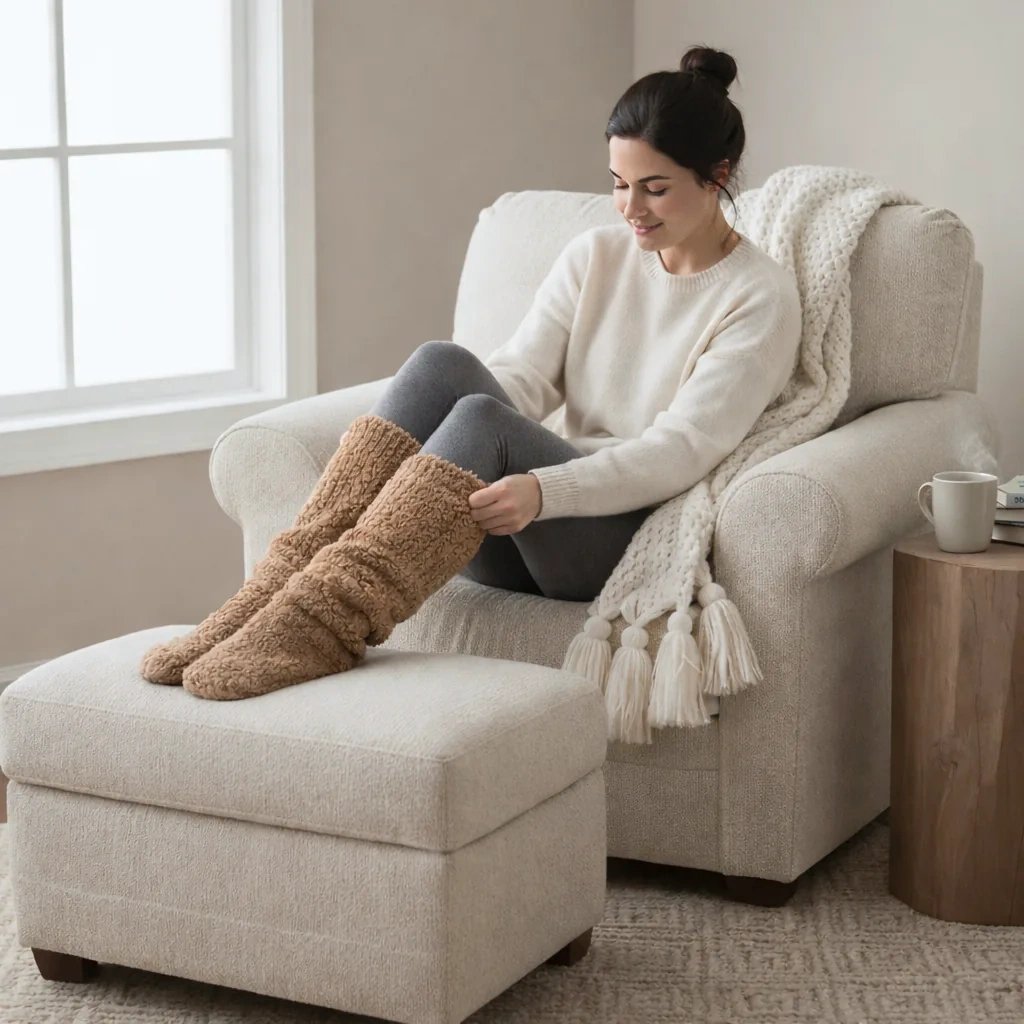
The other half of the list is the part you wear rather than fit to the flat. Jumpers. Thick socks. A blanket over your knees, or over-the-knee fleece leg warmers if the cold starts below them. That half is at least honest about what it does. It warms a person, not a building.
But notice what every item quietly assumes. Each one treats a cold home as your logistics problem. You buy the things. You rearrange your evening around a room that will not warm up. Nothing on that list asks whether the flat itself is at fault.
That question has an answer, and it is written down.
When does a cold flat stop being your problem?
In England, a rented home has to be fit for human habitation. That is not a turn of phrase. It comes from the Homes (Fitness for Human Habitation) Act 2018, and a home that cannot be heated adequately is one of the things that can put a property in question.
Two different routes sit behind that, and most guides blur them. The Homes Act is your landlord’s duty to you, and it can end in court. The Housing Health and Safety Rating System (HHSRS) is the risk assessment your council uses when it inspects a home and decides whether to step in. Cold can matter under both, and they can run at the same time.
England rewrote the HHSRS this summer. Since 23 June 2026 the English system groups housing risks into 21 hazard categories, rather than the 29 it used for two decades. The regulations do not print that total; it is what is left after the paragraphs they remove and the five broader ones they add. The old A-to-J hazard bands went too. Under the new system, Category 1 hazards are described as high risk, while Category 2 hazards are divided into moderate and low risk.
What did not disappear is the split that decides what a council does next. A score of 1,000 or more is a Category 1, or high-risk, hazard; scores below 1,000 fall into Category 2, which is divided into moderate and low risk. Where a council identifies a Category 1 hazard it must take the appropriate enforcement action; for Category 2 the same Act confers a power rather than a duty. Excess cold and damp and mould remain among the hazards. If you read an older page that still says 29, including some government guidance that has not caught up yet, that is why.

Wales is a separate system, not a copy. Under the Renting Homes (Wales) Act 2016, in force since 1 December 2022, landlords must consider 29 matters and circumstances. Cold and damp are among them. Those 29 matters are the Welsh fitness test itself, and Wales runs its own housing-condition enforcement routes alongside it. The Welsh figure is still 29. The English one is not.
Now the limits, because this cuts both ways.
Feeling chilly on its own does not establish that a home is legally unfit. Plenty of homes are simply cold, and that is life in old housing stock. What moves it towards a housing-condition problem is the whole picture. The cause. How long it lasts. Whether the place can be heated adequately at all, whether there is damp with it, and the risk to whoever lives there.
A finding that a home is unfit does not by itself settle whether the landlord is legally responsible for remedying the particular problem or has breached a duty, and none of it obliges a council to take enforcement action. Where that is disputed, a council assessment or a court may be what settles it.
There is also no single indoor temperature that automatically proves a breach. That does not make a thermometer useless. A reading counts for more when it comes with the heating, the draughts, the damp and how long it has gone on.
The distinction still changes something, and this is the part worth keeping. There is a difference between “I am bad at staying warm” and “this building has a defect”. The first is a feeling about yourself. The second is a condition of a property, and conditions of property have a process attached.
Can you use the law on your tenancy?
For most renters in England the first questions are whether you hold a tenancy rather than a licence, and whether your agreement is one the Act covers. It generally applies to leases of less than seven years, with additional coverage for certain secure and assured tenancies granted for seven years or more. The commencement dates now matter mainly for unusual older arrangements: the Act came into force on 20 March 2019 and older tenancies came under it on 20 March 2020. The dates and the exceptions are set out at the end of this page.
One thing to check before the dates. The Homes Act does not apply to a licence to occupy, and the guidance says that can include lodgers, some people in temporary accommodation and some but not all property guardians. Whether an agreement is legally a tenancy or a licence depends on the facts of how you live there, not on what the document is called. That is worth advice rather than a guess.
Then the part the warm-home guides skip. You do not have to start in court. You can contact your local council about conditions in your home. The guidance says councils have powers to take action on your behalf, at no cost to you.
Free is the word doing the work there, so read it precisely. You do not pay the council to look into it, which is not the same as a promise about what happens next. A report on its own does not guarantee enforcement, and the council works to its own thresholds. What creates a duty is what an assessment finds, not the fact that you complained: at Category 1 the council must act, at Category 2 it may. This is a route you open, not a result you order.
It is also not a fallback for people the Act excludes. You can raise serious conditions with the council whether or not you could bring a Homes Act claim, and the two can run at the same time.
If your landlord is the council or a housing association, you are not outside this. You may still have rights under the Homes Act; what differs is the complaint route. Report the repair first. If that is not dealt with properly, use the landlord’s formal complaints procedure, and an unresolved social-housing complaint can then go to the Housing Ombudsman.
Write it down as you go. Report the problem to your landlord in writing and keep the reply. Alongside that, collect the things that show a pattern rather than a bad evening:
- dates and times, and where in the room you took the reading
- photographs of the thermometer, and of any damp or mould
- repair requests with their reference numbers, and any contractor visits
- how the heating behaves when you actually run it
- the thermostat setting, and whether the heating was running when you took each reading
A thermometer at home is supporting evidence, not a verdict. Whoever assesses it looks at the whole situation.
Reporting to your landlord first is what the process expects, and it matters if things go further. But if the condition looks like a serious risk to health or safety, you do not have to wait for that correspondence to finish before you contact the council.
Not renting? Then the repair routes above are not yours to use. Staying warm at home without the heating on is the version of this written without a landlord in it.
What helps tonight while you wait for a fix?
Letters are slow and you are cold now. So how do you warm up a cold rented flat without controlling the heating? You warm yourself and the few feet around you, and you leave the building fabric to the person whose job it is. Here is the part that costs nothing, with one boundary attached to it: layers, blankets and removable draught measures can make an evening more bearable. They do not repair heating, damp or insulation, and they do not make an inadequately heated home safe. If the heating is broken, or you cannot control it, that is the thing to report, not the thing to work around.
Insulate yourself as well as the room. An extra layer changes your own insulation straight away, while warming a cold flat takes time. That helps while a repair is still going back and forth. Start with whatever actually feels cold on you, and keep your middle layered: there is no single right order, and people differ in where they lose warmth first. If it is your legs, how to keep your legs warm at home goes into that.
The list from the top is worth doing, with one thing in mind. For anything you buy or fit yourself, removable is usually the simplest place to start. You are furnishing a flat you will leave. Curtains you can rehang, a rug for the patch of floor where you actually stand, a draught excluder you can lift.
Anything that sticks, drills or stays put is a different question, and the honest answer is: check the agreement. Some tenancies allow it, some need written permission, and window film can affect the glass or the seals. Get the permission in writing where it is needed, and do not take on work that your landlord should be arranging.
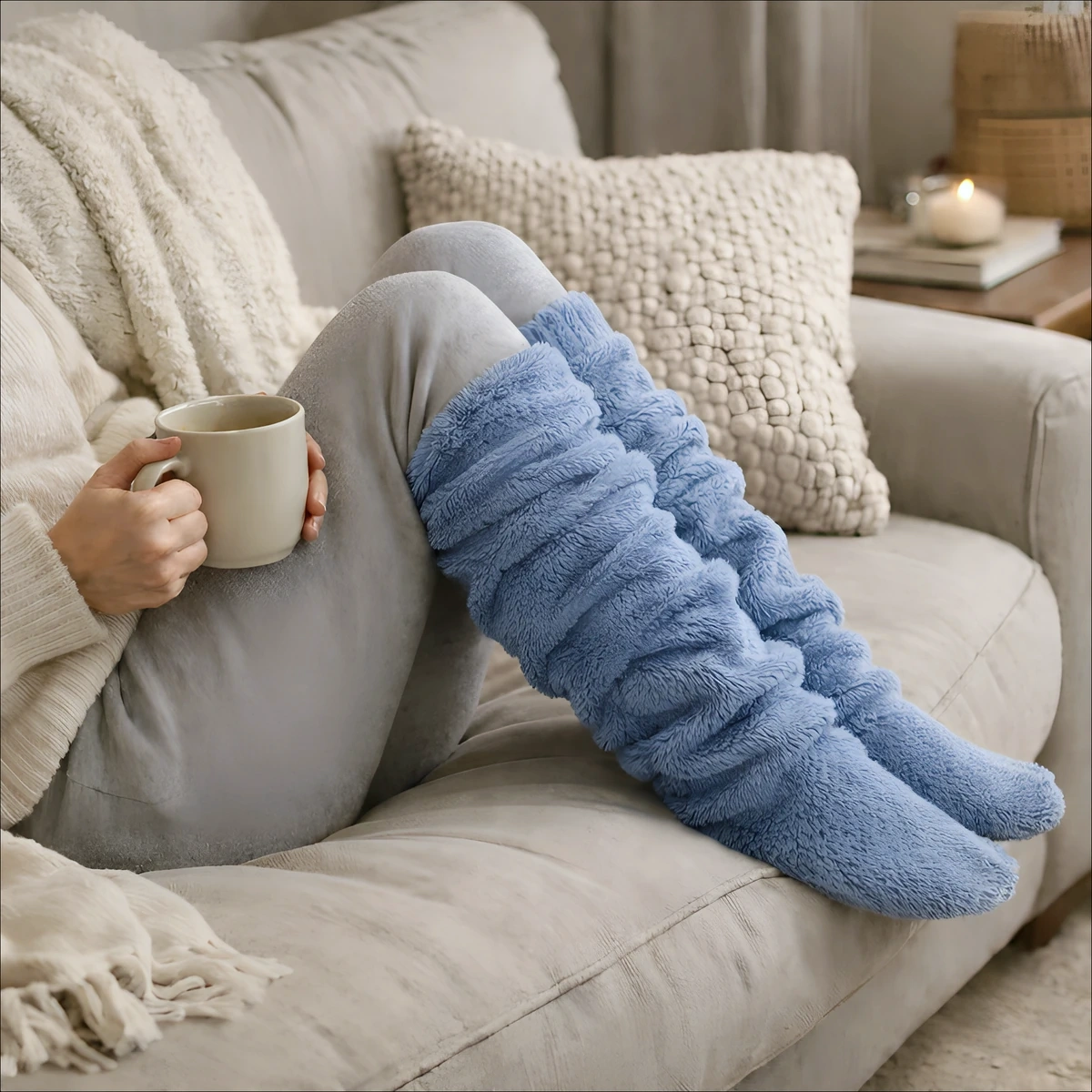
That rule is also why we sell what we sell. Read this as our own product rather than a survey of the market, and as personal comfort rather than a fix. It does nothing about the condition of the flat. Ours are the fleece kind that go over the knee, and they cover the foot, with a flap you can fold under to slip your feet out. They are made primarily for indoor wear. One customer, reviewing on our product page, described the point of that flap better than our own copy does: *”they keep them cozy and the option to have my feet in or out”*. Feet in or out, decided by you, in a flat where the thermostat is not yours.
It is a Sunday, in a flat with a boiler you are not allowed to touch. You draw the curtains before the light goes. You put something warm on your legs and finish the message to your landlord, with the dates in it and a photograph of the thermometer attached. The room is still cold, and it will be until something is actually fixed. The extra layer just makes the wait easier. What changed tonight is that you wrote the cold down and reported it, instead of quietly putting up with it.
FAQ
Sometimes, depending on the cause. In England a rented home must be fit for human habitation under the Homes Act 2018, and a home that cannot be heated adequately may raise questions about whether it meets that standard. Separately, excess cold is one of the hazards councils assess under the HHSRS, which since 23 June 2026 uses 21 hazard categories rather than 29. Wales runs its own regime with 29 matters and circumstances. Feeling cold does not by itself prove a breach. The cause, the duration, whether you can heat the home at all and the risk to health all matter. Where the legal position is disputed, the evidence may ultimately be assessed through a council process or by a court. This covers England and Wales only.
For most English tenants now, yes: the Homes Act has applied to secure, assured, statutory and private periodic tenancies since 20 March 2020, whenever they began. Two questions usually matter more today. Is your agreement legally a tenancy rather than a licence? Does the type and length of your tenancy fall within the Act? Agreements from before 20 March 2019 that still run a fixed term get more complicated. If your status is unclear, check current guidance or get housing advice rather than relying on the name on the document.
Layers, blankets and removable draught measures are the cheap part. An extra layer changes your own insulation straight away, while warming a cold flat takes time. Start wherever you actually feel cold, since that differs from person to person. Keep the fixes removable so they come with you, and check the agreement before anything that sticks or drills. None of this repairs heating, damp or insulation. If you cannot heat the home properly, report that as well.
Report it in writing, early and plainly, and keep the reply. A dated message describing the specific problem, when you noticed it and what the heating is doing gives the landlord something concrete to look into as a repair. Do the reversible things yourself, ask before anything that leaves a mark, and do not take on work the landlord should be arranging. If it stalls, the formal complaints procedure exists precisely so you do not have to argue.