
Why Am I Always Cold in the Office? (Even in Summer)

It was 27°C on the walk in. Now it is August, you are at your desk, and you cannot warm your hands. Most people assume a cold desk in summer says something about them: run down, not eating enough, coming down with something. Often there is nothing mysterious about it. The temperature, the air moving across you, where your desk sits and how little you move can all leave the same room comfortable for one person and cold for another. And the comfort standards behind a room like this were built around an average occupant, which has never described everyone equally well.
Why is an office cold in summer when it is warm outside?
A warm day outside can mean more cooling inside. Sun through the glass, people, lights and equipment all add heat, and the cooling has to be spread across a floor where none of that is spread evenly. Some desks end up cooler than others, especially the ones where the air arrives directly.
That is why the complaint sounds so odd out loud. Shirtsleeves on the pavement, cold hands at your desk. Nothing about you changed between the street and the lift.
Is there a rule about how cold an office is allowed to be?
There is guidance on the cold end, though 16°C is not the simple cut-off people assume it is. What follows is the position in Great Britain; Northern Ireland has its own equivalent regulations. The Health and Safety Executive sets out the law on workplace temperature: the Approved Code of Practice suggests the minimum for working indoors should normally be at least 16°C, or 13°C where much of the work involves rigorous physical effort. Those numbers are guidance inside the legal framework rather than a line drawn in the Act itself. Turn the other way and the same page is blunt. There is no maximum temperature for workplaces.
Read that twice, because it explains why the argument feels unwinnable. The one number that covers being cold is one an air-conditioned office in August can sit comfortably above while you are still cold at your desk. There is nothing left to point at.
What sits there instead is a duty. The same regulations require a reasonable indoor temperature, and separate rules require employers to assess temperature as a risk. HSE adds that they should consult workers on how to cope with it. Saying something does not create that duty, because it is already there. What it does is give your employer a reason to look at thermal comfort as part of it. Worth knowing where that lands: for many ordinary offices the enforcing authority is the local authority rather than HSE, though which one it is depends on the main activity at the premises.
That is also why the conversation with facilities stalls before it starts. You go in wanting a number, and the only one that fits your end of the scale is already satisfied. What you have instead is the word reasonable, and their duty to look at it when you raise it.
Why can a draught make the same office feel colder?
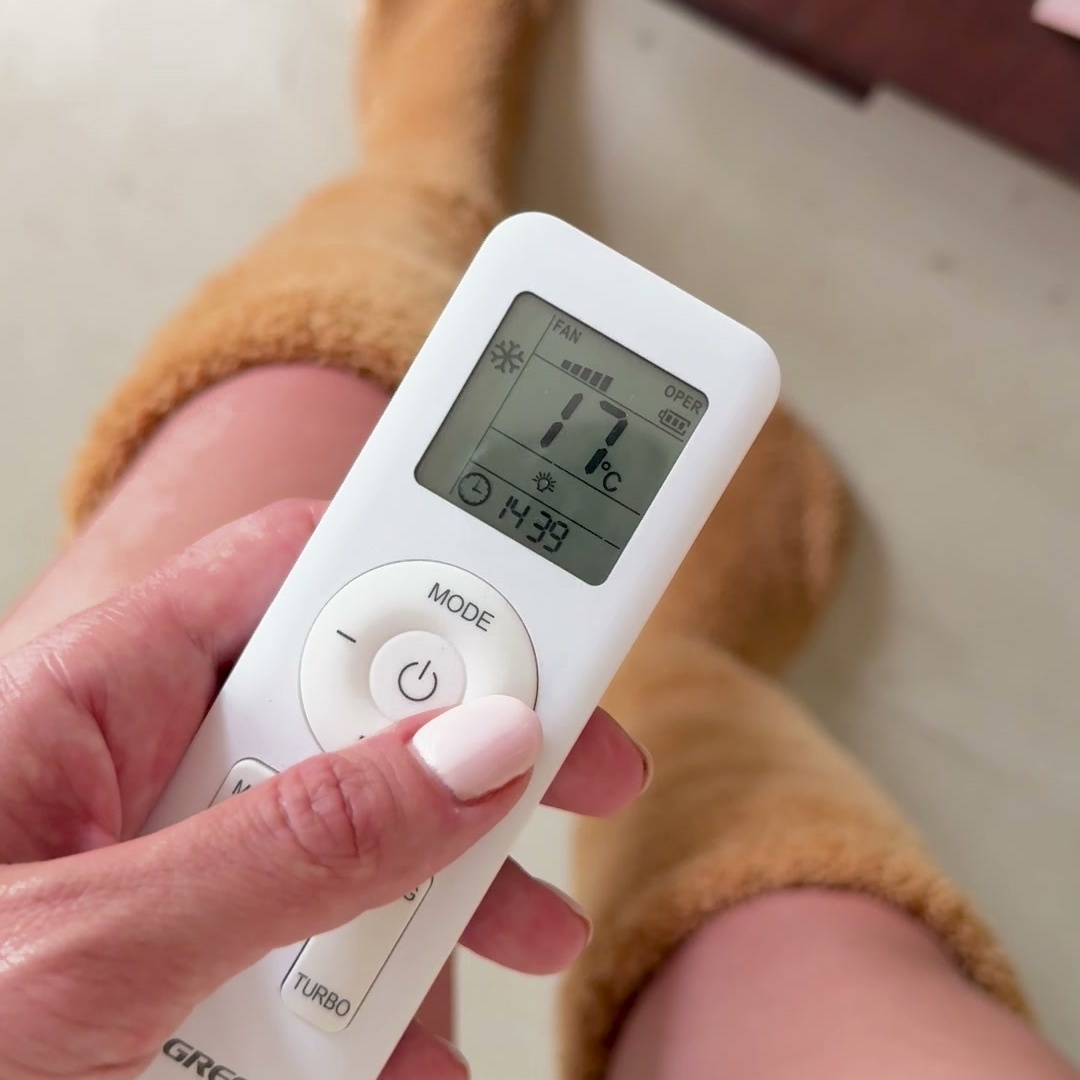
Two desks can read the same on a thermometer and feel completely different, and air movement is one of the reasons. HSE’s guidance on thermal comfort notes that small air movements in cool or cold environments may be perceived as a draught, because people are particularly sensitive to those movements.
If a vent sends air across the same part of you for hours, that can feel draughty even when the room temperature reads perfectly ordinary.
Which is worth knowing before anyone touches the thermostat. If it is the airflow rather than the room, moving your desk a little can sometimes help without changing the temperature for the whole floor. It is also why the colleague who says “it feels fine to me” may be telling the truth about where they sit.
Why does your colleague sit there in a shirt and feel fine?
Here is the part that reframes the whole thing. Indoor climate standards rest on a comfort model, and one of its main inputs was calibrated on an average man.
Kingma and van Marken Lichtenbelt made that case in Nature Climate Change in 2015. The paper itself sits behind a paywall, so the link here goes to the university’s record of it, where the abstract states the finding plainly: standard values for metabolic rate, one of the model’s primary variables, are based on an average male, and may overestimate female metabolic rate by up to 35%. Their analysis looked specifically at what that means for female thermal demand.
The useful point is not that every woman feels colder than every man. It is that one average cannot describe everyone in a room equally well, so two people disagreeing about the same office does not prove that one of them is simply wrong about how it feels. That is worth knowing before you apologise for asking.
This is about a cold room rather than about you. If feeling unusually cold is new, persistent or severe, or arrives with other symptoms, that is one for a GP rather than a cardigan.
Why can your legs and feet feel cold at a desk?
A day at a desk means hours with very little movement in the lower half of you. Depending on what you are wearing, where the air is moving and how your desk sits in the room, your legs or feet can end up the part you notice most. That does not mean they are always the first part of you to get cold. There is more on the body’s side of it in why you feel cold at home when everyone else is fine, which follows the same body without the vent. It is also why the things that help down there are usually local rather than a change to the whole floor: warmer socks, a layer under trousers, or at home the over-the-knee kind that covers calf and knee in one piece instead of stopping at the ankle.
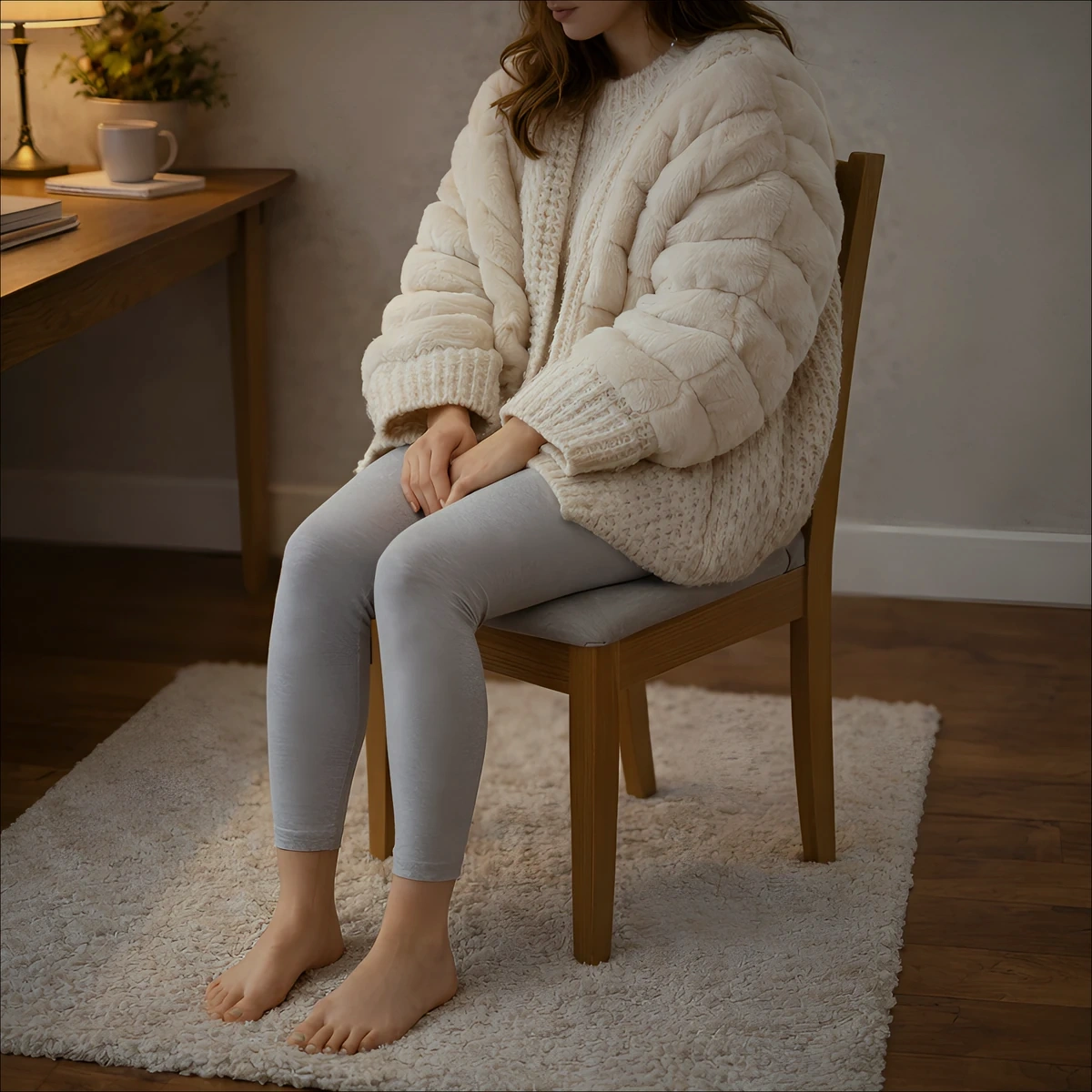
Under a desk, your lower legs also sit in a slightly different little world from the rest of you: shaded, fairly still, sometimes close to a low-level air supply. Whatever the room is doing down there, that is where you spend the day.
What actually helps at a cold desk?
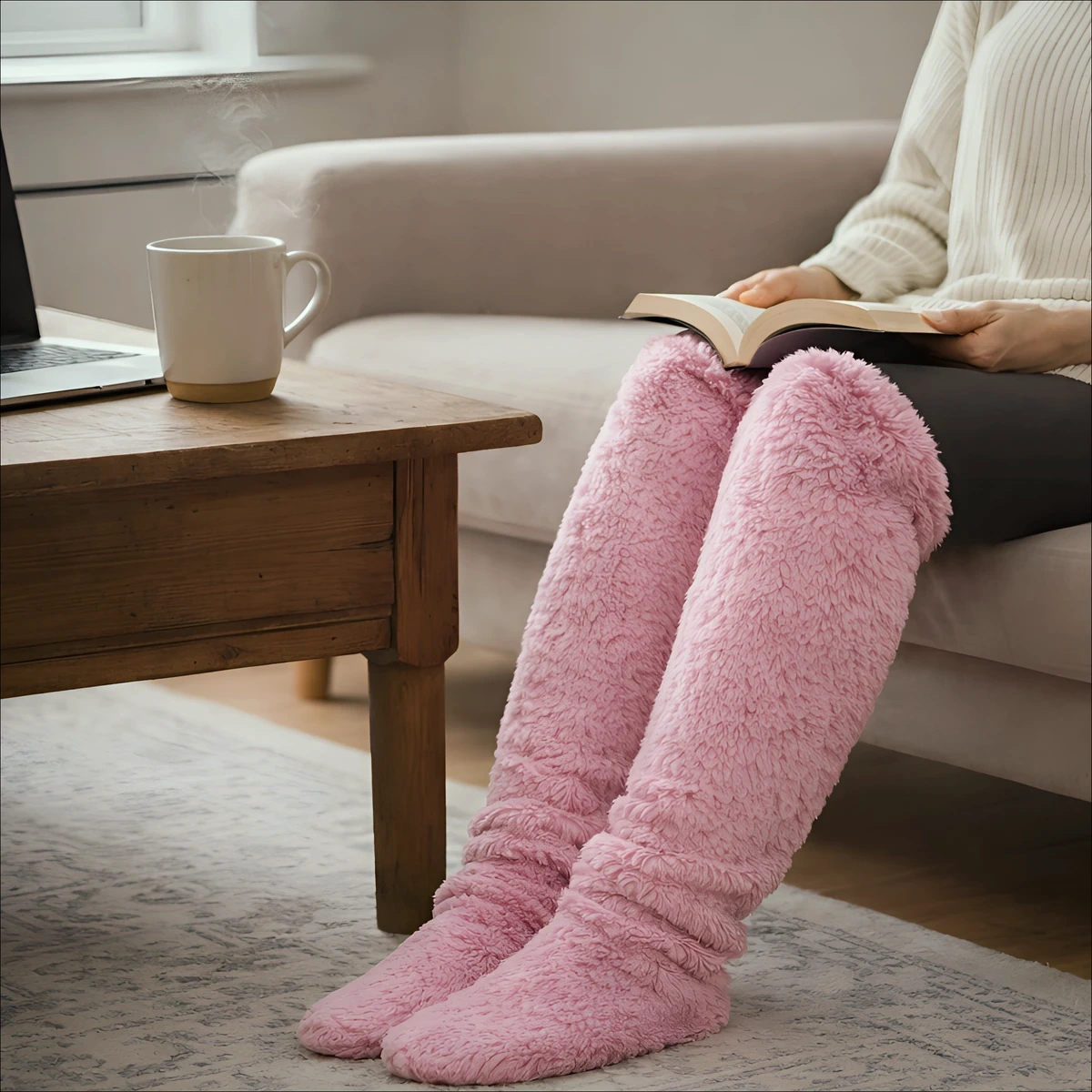
The honest part about us first. We sell fleece leg warmers, and at a conventional office desk they are usually the wrong tool: they are made primarily for indoor wear, and anything that reads as cosy tends to lose an argument with a dress code. Thick socks and an unobtrusive layer under trousers are the easier options there. A home desk is a different question, and it is the one our fleece leg warmers were made for. Soft fleece pulled on over leggings, the foot section folding back so your feet can be in or out, for the hours you barely move. For the rest of the house, the fuller version is in how to keep your legs warm at home.
Then, roughly in the order worth trying:
- Find the draught before you argue about the temperature. Hold a hand near the vent, or watch the edge of a sheet of paper. If air is moving over you, raise that instead. It is a far easier fix than the whole floor’s setpoint.
- Ask to move, even a couple of metres. Out of the direct flow, if there is anywhere to go. A small change in where you sit can sometimes help without changing the temperature for everyone else.
- Describe the draught, not the number. HSE expects employers to look at thermal comfort when people raise it, and saying where and when beats naming a temperature you cannot cite a limit for. Put it in writing, because an email carries a date. Note which days and hours it happens, and where you sit in relation to the vent. A thermometer reading supports that; it does not settle it.
- Cover the part that actually feels cold. If your top half is already comfortable, another jumper may matter less than covering the bit that is not. At a desk that is often below it, where a layer under trousers rarely troubles a dress code. A blanket over your knees is the home version of that, and one most offices will not wear.
- Get up now and then. Every hour or so is a reasonable habit rather than a prescription. Long stretches of sitting still are the part of this you can actually change, and a hot drink warms the hands holding it.
None of this is dramatic. The aim is a desk comfortable enough that your feet stop asking for your attention.
FAQ
Yes, people can feel uncomfortably cool in an air-conditioned workplace even when it is warm outside. Comfort depends on more than the thermostat: air movement, the surfaces around you, what you are wearing, how much you move and plain individual differences all come into it. A desk sitting in the direct supply air can feel noticeably cooler than another part of the same office.
If direct airflow is making you uncomfortable, the draught is the sensible thing to raise first. After that, cover the part that still feels cold rather than reaching automatically for another jumper. At a work desk, thick socks and an unobtrusive layer under trousers are usually the easier options. At a home desk you have more room to play with, and over-the-knee leg warmers over leggings cover the calf and thigh directly.
The Approved Code of Practice behind the workplace regulations suggests that indoor workplaces should normally be at least 16°C, or 13°C where much of the work involves rigorous physical effort. Those figures are guidance within the legal framework rather than a simple statutory cut-off. These are the Great Britain rules; Northern Ireland has its own equivalent set. Either way they only cover the cold end: there is no maximum temperature for workplaces. What applies in both directions is the duty to provide a reasonable indoor temperature and to assess temperature as a risk.
Long stretches of sitting, very little movement, what you are wearing and the air moving nearby can all make feet or lower legs feel uncomfortable while your upper body feels fine. If a vent is blowing across the lower part of your workstation, that adds a local draught as well.
You can ask. Employers already have a duty to assess and manage workplace temperature as a risk, and HSE recommends consulting workers about thermal comfort. What you cannot rely on is a number to point at, because the guidance sets no upper or ideal number for an office. A complaint that describes the draught, where you sit and when it happens is more use than one that names a temperature.